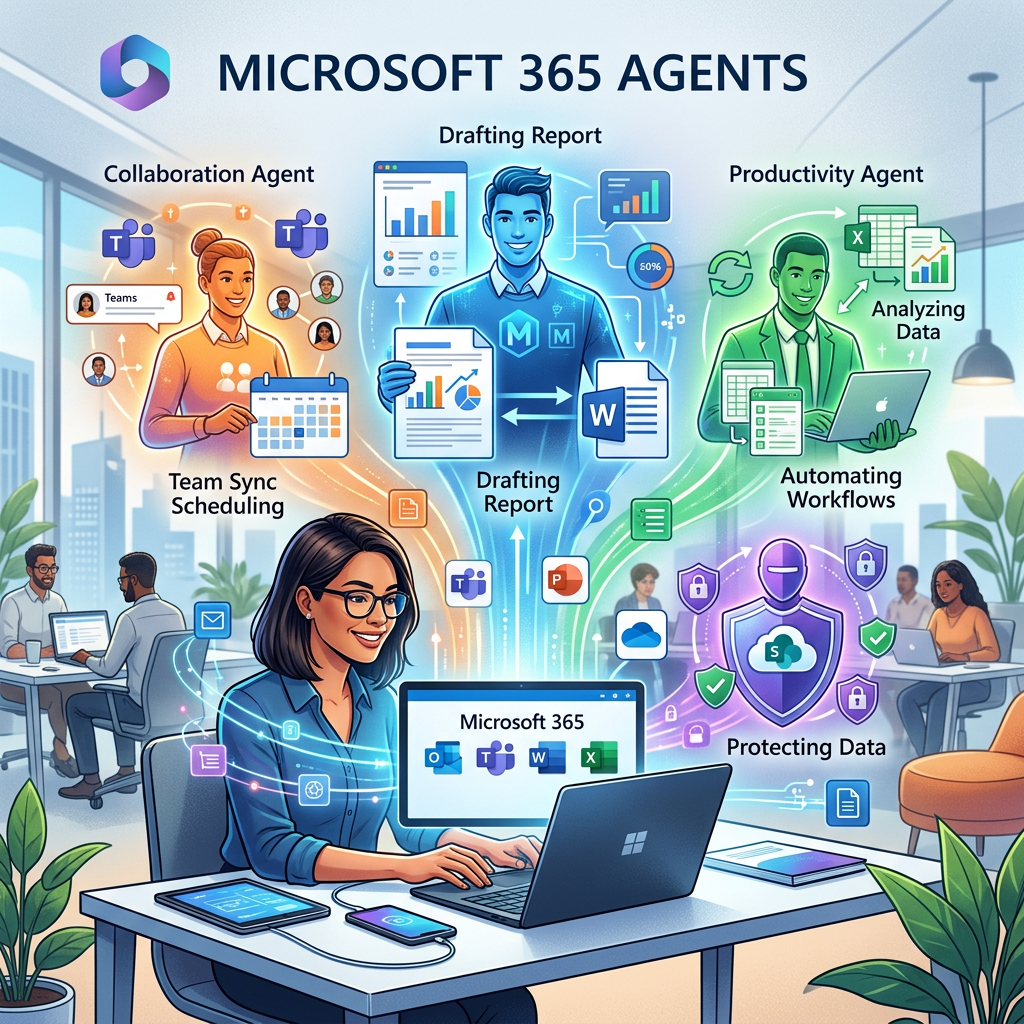
The future of enterprise AI is shifting from passive chatbots to active agents that function as digital teammates. According to Microsoft, these agents aren’t just tools; they have their own identities and access to the same collaboration ecosystems as Teams and OneDrive as human employees. This transition integrates AI directly into the core operations of the modern office, rather than keeping it as a separate utility
What makes this especially important is that Microsoft Agent 365 is not framed as just another app-building feature. Microsoft describes it as a control plane for AI agents, designed so organizations can onboard, organize, secure, and govern agents at scale, including agents built on Microsoft platforms, open-source frameworks, and third-party systems. In practical terms, that means the enterprise problem is no longer simply “How do we build an agent?” but “How do we manage hundreds of agents safely, consistently, and visibly across the organization”. The distinction matters because agent sprawl is likely to become the next major challenge in digital transformation. Every business unit will want an agent for approvals, talent acquisition, finance, procurement, research, service desk interactions, content generation, or project updates. Without a control plane, those agents can quickly become opaque, over-permissioned, and difficult to manage and govern. The Microsoft emphasize that Agent 365 is meant to address exactly this issue by letting organizations onboard agents, assign policies and knowledge, and track what those agents do as adoption grows. That is the strategic unlock: not just more AI, but managed AI.
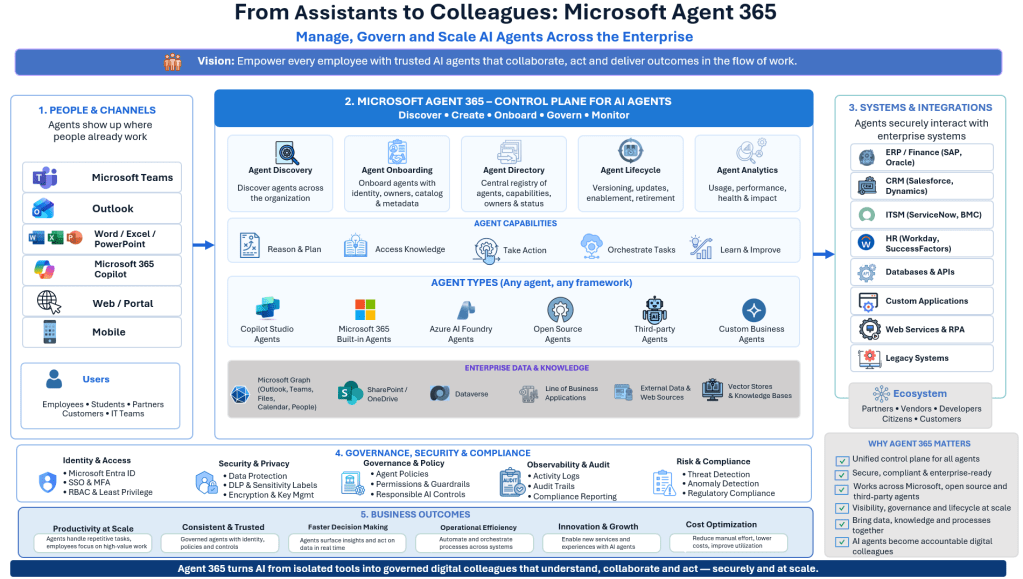
From a digital workplace and adoption perspective, the strongest advantage is the seamless user experience. Microsoft is positioning agents within the existing productivity ecosystem where users already collaborate and execute daily work. These agents can operate with distinct identities and be engaged through native interaction patterns such as across Teams, Word, and Outlook. This significantly lowers the change curve, as users are not required to adopt a separate interface or workflow model to realize value from agentic AI. Instead, AI capabilities are embedded directly into familiar business processes, which reduces user friction, accelerates adoption, and shifts AI from isolated experimentation into an integrated operational capability.
From a security perspective Agent 365 provides a unified control plane to oversee the security of AI agents and extends Microsoft’s security stack to agents built in Copilot Studio, Microsoft Foundry, and third-party solutions. Microsoft also positions Agent 365 alongside Entra-based identity, observability, and governed access so organizations can understand which agents exist, what permissions they have, and what actions they take. For IT leaders, this is the real enterprise differentiator. AI becomes easier to trust when every agent is visible, attributable, and manageable through policies, access controls, and auditability.
Most enterprises do not fail with AI because they lack ideas. They struggle because they lack governance, lifecycle controls, and clarity on ownership. All hearing news coming from different sources that AI has rewritten my code, wiped my databases, caused chaos in the production environment etc, the Agent 365 addresses those practical concerns by giving organizations a way to discover, create, onboard, and manage agents across the tenant. Microsoft also notes that Agent 365 will be generally available on May 1, 2026, signalling that this is moving from concept to platform reality. The strategic implication is that enterprises now need a plan not only for AI use cases, but for agent inventory, agent identity, agent risk, and agent administration.
There is a bigger message here beyond just the technology. If these agents can have their own identity, storage, and access to company systems, they begin to work more like digital team members. This does not mean they will replace people. Instead, it means people can spend more time on tasks that need human thinking, judgment, and relationships, while agents help with routine work like updates, approvals, research, and coordination. The key idea is that AI will work alongside employees, not just act as a hidden automation tool in the background.
The main message is simple: the companies that do best with AI will not just be the ones using the most agents, but the ones managing them well. They will know what agents are being used, what information they can access, how they are being watched, where they are helping, and when they need to be adjusted or removed. What makes Microsoft Agent 365 important is that it shows AI at scale can become risky without proper control, but with the right visibility and management, it can become a real business advantage. So, the bigger question is not whether AI agents will become part of the workplace, but whether organizations are ready to manage them like an important part of their team. Let me comes with more content on this subject till then keep learning!
References: https://www.microsoft.com/en-us/microsoft-agent-365

