
Amazon Q Business integration with Microsoft 365 applications
In the era of AI, every organization aims to enhance the quality of employee productivity and accelerate the end-user experience. Integrating Agentic AI across an ecosystem allows for the handling of specific processes, solving business challenges that are specialized for the workspace. Today numerous AI agents are built for specific purposes, such as prompt-and-response agents, task agents, autonomous agents and so on.
These Agents revolutionize the business operations compared to the traditional automation methods, which rely on predetermined rules and static workflows. Organizations are adopting these Agentic AI tools to augment every aspect of their business including logistics, manufacturing production line, finance, client services, HR process etc. In this blog we discuss Agentic AI Applications for Microsoft 365 Apps, Rather than focusing on Copilot, we are highlighting AWS-heavy client infrastructures where organizations prefer AWS for storing significant data (such as in S3 or RDS) alongside their M365 suite.
Amazon Q is Amazon Web Service’s generative, enterprise-grade AI assistant, and when used in an agentic model with Microsoft 365 platform, it acts as an intelligent helper, digital co-worker that can understand orchestrate tasks, understand the context, take required actions across your Microsoft 365 applications viz Outlook, Microsoft Teams, Word, Excel, and SharePoint.
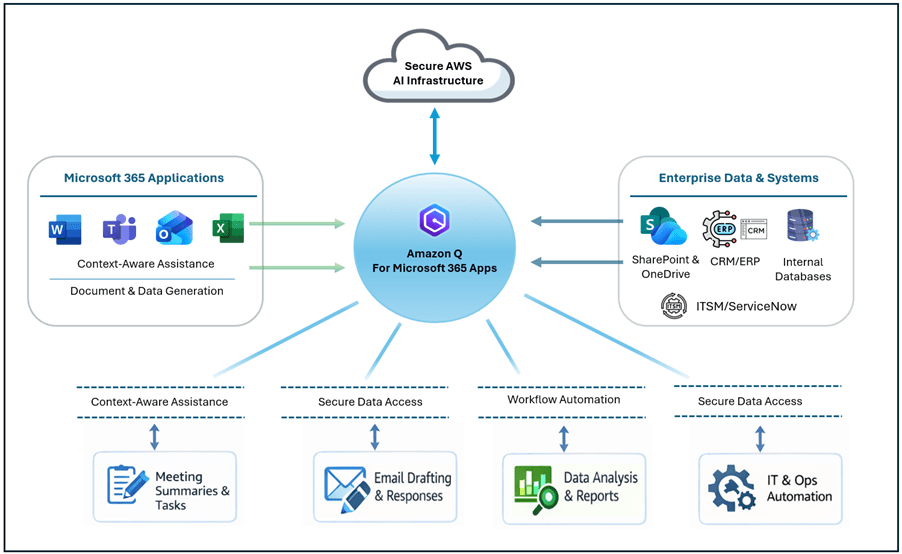
The above diagram depicts the Amazon Q integration with Microsoft 365 apps. The details are described here:
- Central AI Orchestration: Amazon Q acts as the central, agentic AI layer that connects Microsoft 365 applications with enterprise data and workflows, operating on secure AWS AI infrastructure.
- Deep Microsoft 365 Integration: Amazon Q integrates with Outlook, Teams, Word, and Excel to provide context-aware assistance such as email drafting, meeting summaries, document creation, and data analysis.
- Enterprise Data Access: Through secure connectors, Amazon Q accesses SharePoint, OneDrive, CRM/ERP systems, internal databases, and ITSM platforms like ServiceNow, ensuring responses are grounded in trusted enterprise data.
- Agentic Workflow Automation: Beyond answering questions, Amazon Q can trigger actions such as creating tickets, updating records, generating reports, and automating IT and business operations.
- Security & Governance: All interactions respect Microsoft 365 permissions and enterprise access controls, with data isolation and compliance built into the integration.
- Business Outcomes: The integration enables faster decision-making, reduced manual effort, improved productivity, and secure adoption of AI-driven workflows across the digital workplace
A few typical day-to-day use cases [Amazon Q along with Microsoft Apps]
- Employee or end-users can ask Amazon Q in Teams: “Summarize yesterday’s meeting and create follow-up tasks.” Amazon Q reviews Teams chat, meeting notes, and documents, then drafts a summary and action list.
- In Outlook, Amazon Q helps draft responses using context from prior emails and SharePoint documents.
- In Excel, Amazon Q analyses datasets and produces insights or visual summaries without complex formulas.
- For IT or business operations, Amazon Q can trigger workflows (e.g., raise a ticket, update a record)
When client is looking for a vendor-neutral, action oriented and deeply integrated AI assistant that closely operates across Microsoft 365 and other enterprise system Amazon Q is the solution. Amazon Q is designed not just for assisting end-users, but acts as smart agent, it securely connects with all your enterprise platforms such as AWS, M365, ITSM, ERP other internal applications. Executing workflows makes it more flexible for organization where they have complex, hybrid and multi-cloud environments.
Some of the key reasons to choose Amazon Q:
Vendor-Neutral & Cross-Platform AI
Amazon Q works across Microsoft 365 and non-Microsoft systems (AWS services, ERP, CRM, ServiceNow, internal databases), avoiding lock-in to a single ecosystem.
Agentic (Action-Driven) Capabilities
Unlike Copilot’s assistive focus, Amazon Q can take actions—trigger workflows, update records, raise tickets, generate reports—acting as a digital worker rather than just an advisor.
Flexible AI Strategy
Organizations already invested in AWS or pursuing a multi-cloud strategy can adopt Amazon Q without restructuring their Microsoft licensing or roadmap
Stronger Enterprise Data Integration
Amazon Q securely connects to enterprise data sources beyond M365 (e.g., internal apps, data lakes, operational systems), providing answers grounded in business-specific data, not just documents.
Optimized for IT & Operations Use Cases
Amazon Q is particularly strong in IT, engineering, and operations scenarios—supporting automation, troubleshooting, reporting, and operational decision-making.
Summary
Amazon Q represents a shift from AI as a passive assistant to AI as an active digital co-worker embedded into everyday business and IT operations. In day-to-day use, Amazon Q will continuously support employees by understanding context across emails, documents, chats, applications, and enterprise systems, then proactively assisting or acting on their behalf drafting responses, summarizing work, triggering workflows, and resolving operational tasks.
Organizations should perceive Amazon Q not as a replacement for existing productivity tools, but as a strategic AI orchestration layer that spans Microsoft 365 and non-Microsoft environments. The focus should be on enabling controlled, agentic use cases where Amazon Q operates within defined permissions, governance, and security boundaries to drive productivity, efficiency, and consistency. Over time, successful organizations will treat Amazon Q as part of their digital workforce strategy: starting with assistive use cases, expanding into automated operations, and ultimately embedding AI into core business processes to create a more responsive, scalable, and future-ready enterprise.
 Home
Home 