In today’s IT landscape, specifically in the digital workplace, cloud-hosted environments are facing a growing set of challenges centered around complexity, scale, and fragmentation. Organizations are managing hundreds or even thousands of distributed cloud resources across hybrid and multi-cloud architectures. With constant deployments, dynamic scaling, and infrastructure as code, keeping systems stable and observable is increasingly difficult. IT Teams within organizations are struggling to maintain consistent configurations, monitor resource health in real-time, and trace the root cause of incidents across multiple services, APIs, and environments. This complexity not only impacts reliability but also leads to operational fatigue and slower incident response times.
Apart from that, security and compliance remain pressing concerns for any enterprise. The rise in remote work, global collaboration, and interconnected services introduces more attack surfaces and risk vectors. Also, Misconfigurations, outdated TLS protocols, and unmanaged identities can go undetected, leading to potential vulnerabilities. Combined with the pressure to innovate faster, teams are often caught between delivering features quickly and maintaining airtight operational hygiene.
Microsoft has brought a smarter solution to overcome the current challenges that are faced in the digital workplace. Azure SRE Agent is an AI-driven assistant designed to elevate reliability and streamline incident response across Azure-managed services. Azure SRE Agent leverages large language models, continuously ingests telemetry, logs, and metrics to automate RCA, faster remediation, and minimize the operation burden on your IT team. The adoption will help to achieve operational excellence and help to improve the user experience and overall productivity.
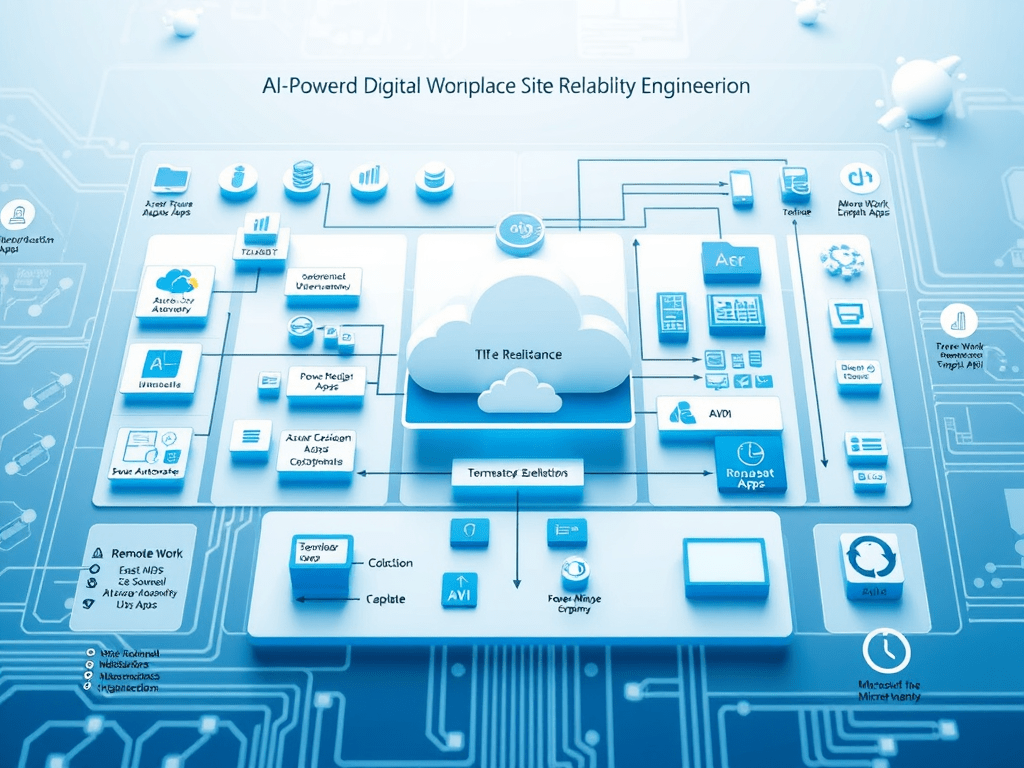
Conceptual layout of SRE with Digital Workplace Services

The preceding diagram depicts an operational architecture for an SRE team. Divided into operational layers and endpoint layers. The operational layer utilizes the telemetry and logs from Sentinel and Monitor. The data is fed to automation and remediation apps, the data triggers workflows within Azure logic apps and Azure functions for automation and enables remediation apps built with Power Automate or custom scripts. For endpoint interaction automation workloads, deploy an SRE agent for endpoints while remediation apps leverage the Microsoft Graph API for programmatic access to Microsoft Cloud Services. These components, in turn, manage and interact with resources in the endpoints layer, which includes AVD for virtualized desktops, Intune for endpoint management, and Microsoft 365 apps for productivity suite administration. The integrated approach ensures a robust, automated, and intelligent system for managing and maintaining endpoint reliability.
🛠️ Core Capabilities: Smart Detection, Proactive Health, and Swift Remediation
Context-aware Monitoring & Q&A
This feature empowers teams with intelligent insights through conversational interaction:
Natural-Language Interface: Engineers can ask questions using regular language—no need to write complex queries.
Example: “What changed in our Exchange deployment last night?”
The agent interprets and parses logs, configs, telemetry, and other data sources to answer with meaningful context.
Instant Summaries: It returns relevant updates, including deployment changes, performance anomalies, and usage patterns across services like Outlook, Exchange, and Teams.
Visualizations & Recommendations:
Graphs and charts help visualize trends (e.g., CPU load spikes, latency, failed logins).
Actionable suggestions are offered to resolve issues or improve performance.
Proactive Security Audits
The agent doesn’t just react; it continuously validates security posture across multiple services:
TLS Compliance Scanning: Identifies weak or outdated encryption protocols used in Exchange, Teams, etc., and flags violations.
Managed Identity Usage Monitoring:
Ensures services are not using hardcoded credentials or secrets.
Promotes the use of Azure-managed identities to reduce attack surfaces.
Deviation Alerts + Auto-Remediation:
Alerts teams in real time to policy breaches or vulnerabilities.
Offers one-click or automated fixes (e.g., enforce TLS 1.2, rotate credentials, apply RBAC policies).
Automated Incident Handling
When trouble strikes, speed and clarity matter, and the SRE Agent delivers:
Trigger Sources:
Listens to alerts from platforms like Azure Monitor, PagerDuty, ServiceNow, etc.
Autonomous Diagnostic Collection:
Automatically gathers logs, metrics, traces, and system snapshots related to the incident.
Hypothesis Formulation:
Uses AI-driven analysis to suggest likely causes (e.g., memory leaks, faulty deployments, network congestion).
Root-Cause Analysis (RCA):
Surfaces conclusions in minutes, often showing causal chains, timelines, and impacted services.
Reduces human toil and accelerates time to resolution dramatically.
Always-On, Multi-Service Awareness
The agent operates 24/7, ensuring continuous reliability and optimization.
It spans multiple Microsoft 365 and Azure services, creating a unified view of your digital environment.
Offers support not just during outages, but throughout deployment cycles, audits, and scaling events.
Transforming Digital Workplace Service Applications:
Azure SRE Agent expands its intelligence across Microsoft’s enterprise products:
Microsoft Outlook, Exchange & Teams: The agent surfaces trends like message latency, sync failures, or service-side errors. It can initiate actions like restarting services or scaling infrastructure with user approval, reducing service interruptions before users even notice.
Microsoft Azure Virtual Desktop (AVD): For Azure Cloud VDI environments, the SRE agent detects session drops, host pool performance anomalies, and underlying VM issues. It can recommend or initiate scale-outs, host reboots, or session host replacements/reimaging to maintain seamless user experiences.
Microsoft Intune Device Management: Azure SRE Agent adds oversight to endpoints by flagging policy sync failures, outdated devices, or non-compliant configurations. It can prompt devices to initiate compliance syncs or suggest/fire predefined PSI scripts to remediate issues across the fleet.
Microsoft Azure SRE Agent integrates natively with Azure Monitor, GitHub, and PagerDuty solutions, which support platform-level metrics, application insights, audit logs, and alerts from Azure. Also flexible to embed into existing ITSM platform (ServiceNow), Azure DevOps, and observability workflows. Every incident concludes with GitHub issues summarizing findings, boosting collaboration between the SRE Agent, IT, and the concerned development team.
Azure SRE Agent is like having a tireless expert managing your cloud ecosystem around the clock. It draws on Microsoft’s experience running massive-scale services to bring proactive monitoring, intelligent automation, and quick incident response across platforms like Exchange, Teams, AVD, and Intune. By automating repetitive operations and focusing on high-value interventions it helps your teams shift from reactive firefighting to strategic innovation.
 Home
Home 
Leave a comment